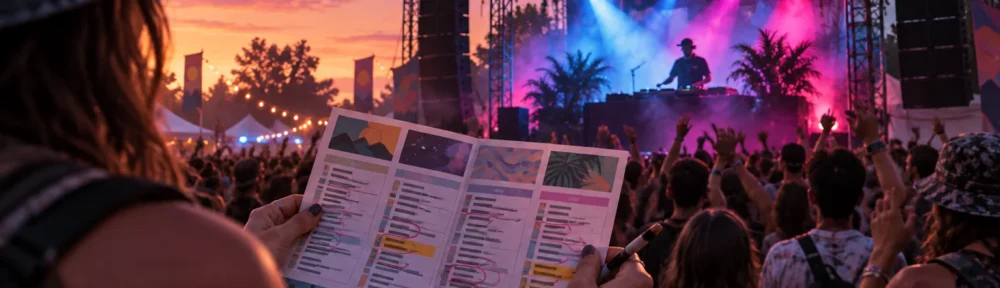
TLDR: To discover DJs festival undercard research should begin with the festival’s official lineup and stage programming, not the smallest names on its poster. Sort unfamiliar artists by stage or host, sample one recent release and one longer DJ set, shortlist five names, and leave one open slot for an unplanned find.
The fastest way to discover DJs festival undercard talent is to stop treating the lineup as a ranking. Poster position tells you who is being promoted most prominently; it does not tell you which unfamiliar artist best matches your taste. Give yourself 20 minutes away from the headline tier, and the lineup becomes less like a wall of names and more like a map of connected scenes.
What “festival undercard” means in EDM
“Undercard” is useful audience shorthand for the non-headline portion of a lineup. It can include emerging artists, established specialists, local selectors, touring acts making a festival debut, and respected DJs whose names simply receive less space on a poster. It is a discovery category, not a verdict on quality or career status.
Billing can also change as a festival reveals additional phases. Ultra Music Festival, for example, said one Phase 2 announcement added more than 70 acts and included support artists making festival debuts. That illustrates why an early poster should not be treated as a complete listening guide. Check the final official lineup before building your shortlist.
Read the stage before judging the artist
A stage, host, or takeover can reveal more than font size. Promoters often group artists around a label, genre, party brand, regional scene, or particular approach to dance music. If you recognize one name or host in that ecosystem, the neighboring unfamiliar names become logical candidates.
Tomorrowland’s 2026 announcement, for instance, describes programming built around EXHALE, hard techno at Atmosphere, and a dedicated deep Afro-house stage. Its official lineup page also offers artist- and timetable-oriented views. Those structures let listeners investigate a musical neighborhood rather than search every artist at random. You can use the official Tomorrowland lineup view as an example of how a large festival organizes discovery information.
Special programming deserves the same attention. Electric Forest separates lineup information from set times and highlights areas such as stage takeovers and Silent Disco programming. That means the useful planning unit may be a host, stage, or late-night program rather than one isolated artist.
A six-step system for finding unfamiliar DJs
1. Start with the complete official lineup
Use the festival’s website, timetable, or official app when available. Fan-made posters and playlists can help with orientation, but they may omit additions, use outdated billing, or confuse similarly named artists. Save the official source and revisit it after later lineup phases and the timetable release.
2. Sort names by stage, host, or sound
Do not open 40 artist pages in alphabetical order. First identify two or three stages that overlap with your taste. A techno host, bass stage, house label takeover, local showcase, or experimental program gives you a manageable starting pool.
Genre labels are clues rather than contracts. DJs can play differently according to the room, time, and artists around them. Use the stage context to choose whom to investigate, not to decide exactly what the set must sound like.
3. Run a three-part listening test
Spend roughly five minutes on each promising name. Start with one recent original track to hear the artist’s production identity. Then sample a current DJ mix, radio session, or recorded set to hear selection and pacing. Finally, check another release or collaboration to determine whether the first track was representative.
Tracks answer “What does this artist make?” Longer sets answer “Where might this DJ take a crowd?” For festival planning, the second question is often more important. Jump through different sections of a mix instead of judging its opening minute alone.
4. Follow labels, collaborators, and cities
A release on a familiar label can position an artist within a sound, although labels often have broad catalogs. Collaborators and back-to-back partners can expose another useful connection. A city reference may lead toward a local club ecosystem, resident series, or regional style worth exploring.
“B2B” means back-to-back: two or more DJs share a set, usually alternating or responding to one another rather than delivering separate performances. The pairing can suggest a meeting of styles, but it does not guarantee a fixed format or equal playing time. Research both artists before deciding whether the combination fits your schedule.
5. Resolve conflicts only after official set times arrive
Before the timetable is published, create a ranked shortlist rather than a rigid itinerary. Once official set times arrive, compare overlap, walking distance, expected energy, and how easily you could see each artist elsewhere.
Give priority to a rare B2B, special live presentation, local artist, or stage-specific set when it genuinely interests you. A frequently touring artist may be easier to catch later, but verify that assumption rather than building a plan around it.
6. Protect one exploration window
Leave at least one 30- to 60-minute block open. Use it to follow a sound drifting from a smaller stage, arrive early for the next act, or stay when an unfamiliar DJ earns your attention. Discovery becomes difficult when every minute is assigned before you enter the grounds.
Which signals are actually useful?
| Signal | What it can reveal | Fastest way to use it | Limitation |
|---|---|---|---|
| Stage or host | Likely musical neighborhood and programming identity | Research two unfamiliar names beside one artist you know | Artists may adapt their sound to the slot |
| Recent release | Current production style | Sample one original track and one collaboration | A produced track may not represent the DJ set |
| DJ mix or recorded set | Selection, transitions, pacing, and range | Jump to the opening, middle, and final third | The festival slot may have different length or context |
| Label connection | A wider catalog and network of related artists | Trace one release to the label’s recent output | Labels can release several styles |
| Set time | Likely energy role and schedule conflicts | Compare time, stage, and walking distance | Time alone does not predict quality or intensity |
| City or local connection | Possible regional scene and club context | Look for official biographies, venues, and event affiliations | Location is context, not a genre guarantee |
Worked example: turning 30 names into three sets
Imagine a fictional festival announces 30 DJs you do not recognize. The bill has four areas: a main stage, a warehouse stage hosted by a techno party, a house-focused garden, and a bass stage with an evening label takeover.
First, choose the warehouse and garden because those match your current listening. That cuts the pool from 30 names to 14. Next, sample one recent track from each artist and remove the names that clearly miss your mood. Eight remain.
Now find a longer mix or recorded set for those eight. Three have compelling tracks but sets that feel too aggressive for the afternoon you want. Two others overlap heavily with artists already on your schedule. Your shortlist is now three: one early warehouse DJ with patient pacing, one garden selector whose mix crosses several house styles, and one local B2B that appears unlikely to recur in the same form.
Those are not declarations that the three are “best.” They are the strongest matches for your taste, schedule, and opportunity. Save two as priorities and make the third a flexible option. That is enough structure to prevent indecision without turning the festival into homework.
How to discover DJs once you are on-site
Arrive for earlier programming when practical. Early slots can offer more room to move, shorter lines, and time to understand the layout, although conditions vary by event. More importantly, arriving before your first must-see act gives unfamiliar music a chance to interrupt your plan.
- Read stage signage and program descriptions instead of relying only on the central poster.
- Give an unfamiliar set 10 to 15 minutes when your schedule allows; one transition is rarely enough evidence.
- Record the artist name, stage, and time in a note so the discovery survives the weekend.
- Use track-identification tools only where reception, event rules, and consideration for people around you allow.
- If a set is not connecting, move on without treating that as a judgment of the artist’s entire catalog.
- Check schedule updates through the festival’s official channels, because assignments and times can change.
After the festival, move promising tracks and artists into a temporary listening queue rather than permanently saving everything. A focused second-listen process, like this guide to building a personal new-music queue, helps separate the adrenaline of the moment from music you will genuinely return to.
The 30-minute pre-festival checklist
- Open the final official lineup and mark every artist you already know.
- Choose two stages, hosts, or programming areas aligned with your taste.
- Select 10 unfamiliar names from those areas.
- Give each name a quick recent-track sample; retain five.
- Listen to part of a mix or recorded set from each finalist.
- Mark two priority discoveries and three flexible options.
- When official set times arrive, check conflicts and walking distance.
- Leave one schedule block intentionally open.
Thirty minutes is enough for a useful first pass. If a lineup is enormous, do not increase the workload until you have exhausted the best contextual clues. Five well-researched possibilities are more useful than a playlist containing every artist on the bill.
Build a schedule that can still surprise you
Festival discovery works best between total improvisation and timetable micromanagement. Use official lineup information to understand the stages, use tracks and longer sets to test your interest, and use the final timetable to make the plan realistic. Then leave enough air in that plan for the grounds themselves to change your mind.
Pick one upcoming festival today. Shortlist five unfamiliar artists, promote two to priority status, and reserve one open set slot. The goal is not to predict the next superstar. It is to come home with one DJ, label, or local scene you would not have found by staring at the largest names.